Life before the label: five questions before choosing a Bali branded residence or a bespoke villa
Before choosing a Bali branded residence or a bespoke villa, settle five things: your year in the house, title, running costs, permits, and design control.

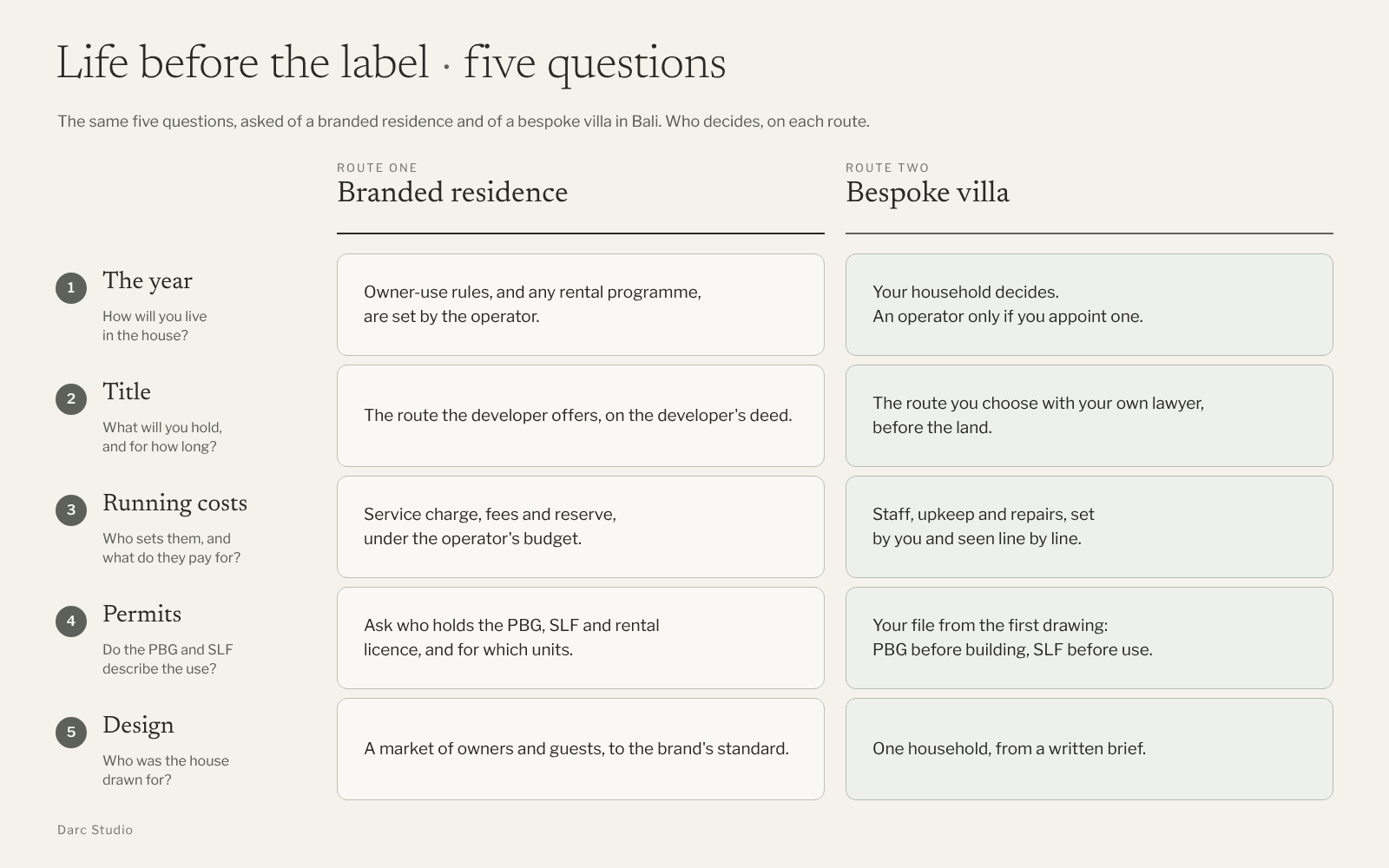
A branded residence in Bali sells a finished way of living, run by an operator to a brand's standard. A bespoke villa is drawn around your own. The choice depends less on the name on the gate than on five answers: how you will use the house, what title you can hold, who sets the running costs, whether the permits describe that use, and how much of the design you need to decide. Settle those before you compare brochures.
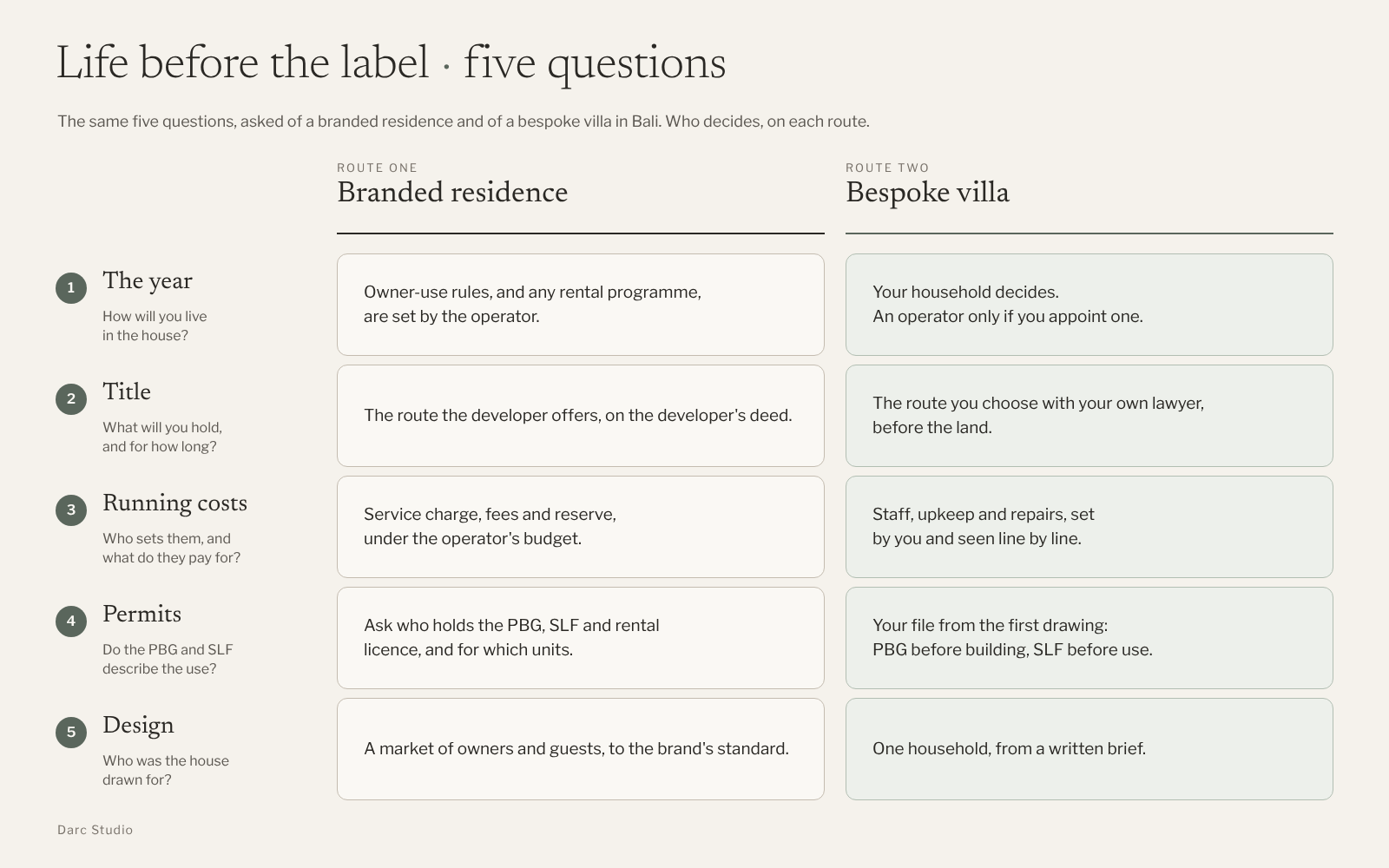
Editorial diagram. The same five questions, asked of a branded residence and of a bespoke villa.
What the brand adds to a Bali residence
A branded residence is a home sold under a hotel or lifestyle brand, usually with the brand's services and often with its management. Savills, which tracks the sector, measures the average premium these homes command over comparable unbranded homes nearby, and its Asia Pacific report lists Bali among the region's branded-residence hotspots (Savills Asia Pacific, July 2025).
The premium buys something real: a known standard, trained staff, a rental desk, someone to call when the pump fails. It also pays the brand. In 2021 Savills told developers that brands are paid through design and technical fees, annual management fees and a royalty that usually sits between 2.5% and 6% of sales revenue, and that a brand's fit-out standards can raise construction costs (Savills, Sep 2021). Savills' 2025 study adds that brand alone is not enough; delivery, location and operation decide how a scheme performs (Savills Branded Residences 2025/2026).
For a buyer the useful question is narrower. What will the brand do for you in the weeks you are there, and what will it decide for you in the weeks you are not?
Who this comparison is for, and what changes the answer
This is for buyers weighing a unit or villa in a branded scheme in Bali against commissioning their own villa on land they secure, including Jakarta households and owners living abroad. The answers shift with:
- How many weeks a year you will be in the house, and who comes with you
- Whether rental income is part of the plan, or the house should stay private
- The nationality and residence status of whoever will hold the title
- Whether you want to choose the land, or accept the scheme's site
- How much time you can give to a design and a build, and from where
Choosing and checking land for a bespoke villa is set out in Land before the line. This piece compares the two routes and stays with the decision before the land.
The five questions
Put each answer on one page with its source: a draft deed, an agreement, a permit, a notary's note. A notary, a lawyer, a tax adviser and the architect each own part of it.
1. The year: how will you live in the house?
Ask: how many weeks you will stay, in which months, with whom, and who decides what happens to the house for the rest of the year.
Why: Agents surveyed by Savills report that many branded developments operate under tourism licences or require owners to join a mandatory rental programme, and that buyers need to know what those restrictions mean for ownership (Savills, 2025). Where there is a rental pool, ask how your own stays fit around it. That suits an owner who comes twice a year and wants the house earning in between. It suits a family that arrives for every school holiday less well. A bespoke villa has no operator unless you appoint one. It can be planned for the way the house will be used: a family wing that closes when you leave, a room for staff, locked storage for what stays.
Request:
- Whether the rental programme is mandatory or optional, and on what terms you can leave it
- The owner-use rules: how far ahead you must book, which weeks are blocked, who else may stay
- For a bespoke villa, who would look after the house between visits, and where they would live
Common failure: Buying for the fortnight of the first visit, then finding the rest of the year belongs to the rental calendar.
2. Title: what will you hold, and for how long?
Ask: the exact right you will hold, in whose name, for how many years, what the extension depends on, and what happens at the end.
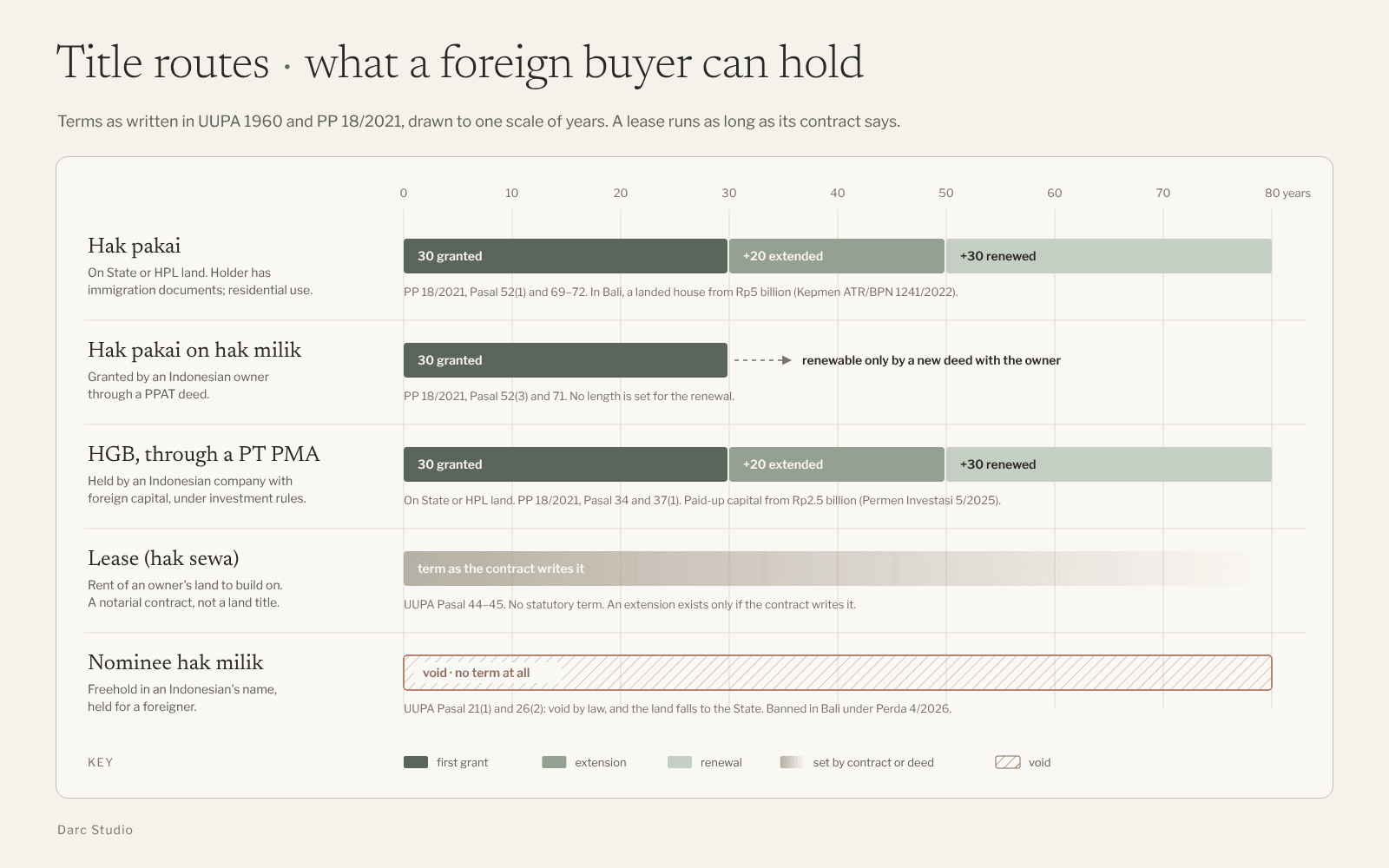
Why: Under the Basic Agrarian Law, only Indonesian citizens may hold hak milik, and any sale or other act meant to pass it directly or indirectly to a foreigner is void, with the land falling to the State (UU 5/1960, Pasal 21 and 26). Bali's Perda 4/2026, signed in February 2026, also bans control of land through nominees and sets sanctions for anyone who acts as intermediary or facilitator (Tribun Bali, 26 Feb 2026). Three routes remain open to foreign buyers:
- Lease (hak sewa untuk bangunan). The same law lets foreigners domiciled in Indonesia rent land to build on. According to the Bali law firm The Bali Lawyer & Notary, the Agrarian Law sets no fixed maximum term, so the length is whatever the parties negotiate, and an extension is only as secure as the clause in the lease deed that grants it (The Bali Lawyer & Notary, Jun 2026).
- Hak pakai. Under PP 18/2021, a foreigner with immigration documents can hold a landed house on hak pakai: up to 30 years, extendable by 20 and renewable by 30 on State or HPL land, or 30 years renewable by deed on hak milik land. Pasal 72 limits it by minimum price, plot size, number of plots and use as a residence. For Bali the minimum price is Rp5 billion for a landed house and Rp2 billion for an apartment unit (Kepmen ATR/BPN 1241/2022).
- HGB through a company. HGB goes to Indonesian citizens and Indonesian legal entities, for up to 30, 20 and 30 years on State land (PP 18/2021, Pasal 34 and 37). A foreign-owned PT PMA qualifies (Hukumonline), but it is a business with its own rules: at least Rp2.5 billion paid-up capital, and over Rp10 billion of investment per business classification and project location, counted including land and buildings for property and accommodation businesses (Permen Investasi 5/2025, Pasal 26).
In a branded scheme the developer decides which of these is on offer. For a bespoke villa you choose, with your own lawyer, before the land is secured.
Request:
- The draft sale or lease deed and the land certificate it rests on
- The term, the extension wording and its price or formula, and what happens to the building at the end
- Your own notary's written note on which route fits your status, independent of the seller's notary
Common failure: Reading a lease marketed as "30 + 30" as sixty certain years. The second term is only what the contract makes it.
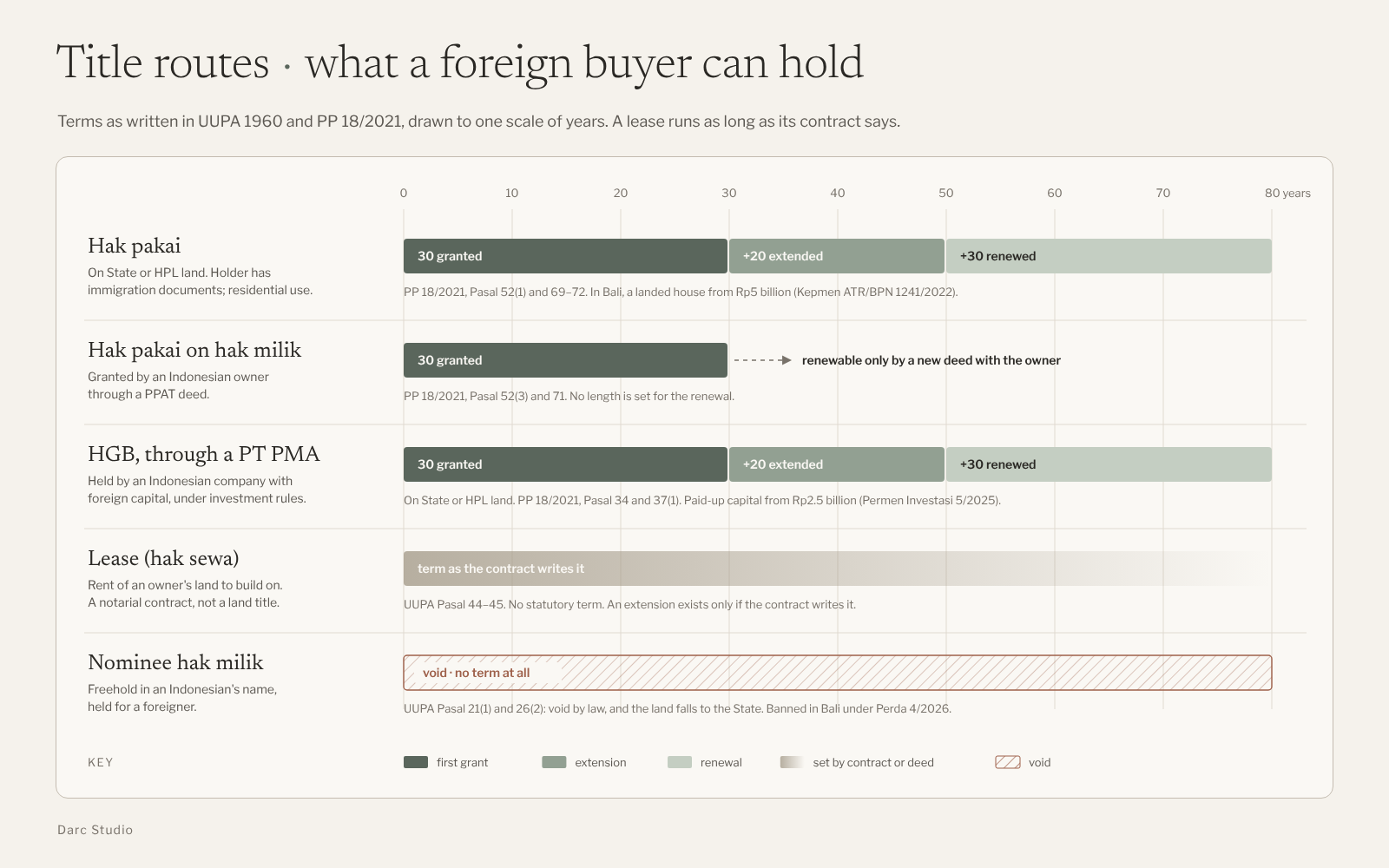
Editorial diagram. Title routes open to a foreign buyer in Bali, with terms from UUPA, PP 18/2021 and the investment rules.
3. Running costs: who sets them, and what do they pay for?
Ask: the service charge, the management fee, how rental income is split and reported, what goes into the reserve for furniture and equipment, and who can change each of them.
Why: In Savills' 2025 report, agents say service charges top the list of buyers' concerns, even among very wealthy buyers. Sharing amenities with a co-located hotel is one way to contain them, but it can blur how the service charge is allocated and cost owners privacy, with hotel guests passing through (Savills, 2025). Keeping a scheme to a brand's standard after handover is part of what those charges pay for. A bespoke villa carries the same kinds of cost: staff, pool, garden, repairs, insurance. The difference is that you set them and can see each line. We do not publish typical figures for either route; they depend on the scheme, the size of the house and the level of service.
Request:
- The management and rental agreement in full, including fees, the income split and how owners are paid
- For a completed scheme, the last two years of service-charge accounts; for one off plan, the budget and who approved it
- For a bespoke villa, a first running budget built by line, before the design is fixed
Common failure: Comparing purchase prices and leaving out what each house costs to keep.
4. Permits: does the paperwork describe the use?
Ask: what function the building's PBG and SLF state, whether that matches how it will be used, and which business licence covers any rental.
Why: Under PP 16/2021, the PBG is the approval to build and the SLF certifies a building as fit for its function before it is used. A building's function, such as hunian (residence) or usaha (business), is written into both, and a change of function needs an amended PBG (Pasal 1, 4 and 11). Rental licensing is also being enforced. On 3 June 2026 the Minister of Tourism told the DPR that more than 1,600 villa and other short-stay listings across Indonesia had been shown to have no business licence and were planned for removal from booking platforms from 1 August 2026 (Bisnis.com, 3 Jun 2026). In August 2025 Satpol PP Badung stopped a foreign-owned villa in Kutuh that was operating with no PBG or SLF (NusaBali, 27 Aug 2025). If you plan to hold hak pakai and rent the house out, ask your notary how that sits with the residential use in PP 18/2021. In a branded scheme, ask who holds which permit and licence, and whether they cover your unit. For a bespoke villa, the file is yours from the first drawing; the sequence is in Bali villa site, PBG and SLF.
Request:
- Copies of the PBG and SLF for the building or unit, with the function they state
- The business identity number (NIB) and business classification that cover the rental, and in whose name
- For a scheme still under construction, who will apply for the SLF and when
Common failure: Accepting "the operator handles the licences" without seeing a single one.
5. Design: who was the house drawn for?
Ask: what the brand standard fixes, what you may change inside and out, and who approves a change.
Why: Brands set build and fit-out standards that developers must meet (Savills, Sep 2021). A branded unit is drawn for a market: owners and guests in rotation, one unit ready to let like the next. That is its strength when it earns. A bespoke villa is drawn for one household: where the grandparents sleep, where work happens, what stays closed when guests come, how the house behaves in rain and in heat. The privacy side of that brief is set out in Silence before the view. The cost is time and responsibility. Land, permits, the builder and the schedule all sit with you and the team you appoint.
Request:
- The scheme's design guidelines and the alteration rules in the deed or house rules
- A list of what is included at handover and what the operator replaces on its own schedule
- For a bespoke villa, a written brief of the rooms and routines your life needs, before land is bought
Common failure: Assuming a branded unit can be made personal after handover in the way your own house can.
How we put the two routes side by side
We have no branded-residence or Bali villa case from our own work that we can publish, and we will not invent one.
What we can describe is the order we work in. We start with the year on one page: weeks in residence, who comes, whether the house should earn. Then the title, with the client's own lawyer, because it can rule a route out. Then running costs and permits, read from documents rather than brochures. Design comes last, because by then it is clear who the house is for. If the rental calendar decides most of the year, a branded or managed scheme can be the honest answer. If the household decides it, the brief is worth more than the label.
What each route asks of you
A branded residence asks for a premium, fees you do not set, and rules on use and change. It gives back a finished house, a standard someone else maintains, a rental desk if you want one, and little of your time. The premium is an average across schemes, not a promise for any one of them.
A bespoke villa asks for time, decisions and the risks of land, permits and a builder, carried by you and your team. It gives back control of the site, the plan, the title route within the law, and who uses the house when. It also leaves you to arrange the management a brand would have supplied.
Neither is right for every buyer. The year you sketched in question 1 decides more than the purchase price does.
Where Bali buyers go wrong on either route
- Treating the brand as the decision, before deciding how the house will be used.
- Signing into a mandatory rental programme without reading the owner-use rules.
- Reading a "30 + 30" lease as sixty secured years.
- Holding land through a nominee, which the law voids and Bali's Perda 4/2026 now sanctions.
- Comparing prices without service charges, management fees and the reserve.
- Assuming the operator holds every permit and licence for your unit.
- Commissioning a bespoke villa without a brief, then designing for guests the family never invites.
To bring to the first conversation
- The year on one page: weeks in residence, who comes, and whether the house should earn.
- The nationality and residence status of whoever will hold the title, and your lawyer's note on the routes open to you.
- For a branded scheme: the draft deed, the management and rental agreement, the owner-use rules, the service-charge budget or accounts, and the PBG and SLF.
- For a bespoke villa: the land certificate, the draft lease or hak pakai deed, and the site checks from Land before the line.
- The design rules you would live within, or a written brief of the rooms your life needs.
- The name of whoever will look after the house when you are not there.
If the first line is blank, the rest are guesses.
Decide the year first
Decide how the year in the house will run before you choose who runs it. This is a set of questions, not legal, tax or investment advice. Confirm the title, permits and agreements for any property with the notary, lawyer and licensed professionals qualified to answer them.
“What will the brand do for you in the weeks you are there, and what will it decide for you in the weeks you are not?”