Luxury Home Architect Fees: Components and How to Read Them
Architect fees for premium homes in Jakarta cover stages, exclusions, and cost basis — not a single %. How to read the proposal. (Sep 2026)

An architect fee for a premium home in Indonesia is not one headline percentage. It is a package of stages, deliverables, exclusions, and a defined cost basis — plus rules for revisions and site work. In Jakarta and similar markets (Sep 2026), compare proposals on the same scope rows. A lower % that omits permits, engineers, or construction observation is not cheaper; it is incomplete.
Decision context
This is for owners hiring an architect for a premium residence or private villa in Indonesia, Jakarta first — hire-intent, not browsing for type-house packages. The right fee structure shifts with:
- Plot complexity, neighbours, and regulatory path (PBG and related authority work)
- Brief maturity (locked area and program vs still exploring)
- How much interiors, landscape, and specialist engineering you want under one lead
- Whether you need tender support and site observation through construction
- How many revision rounds you expect before freezing the design
- Cashflow preference: staged fixed fees vs percentage tied to construction cost
If you only want a contractor sketch for a low-cost build, this article is not for you.
Decision framework — fee components to read
1. Stages and deliverables
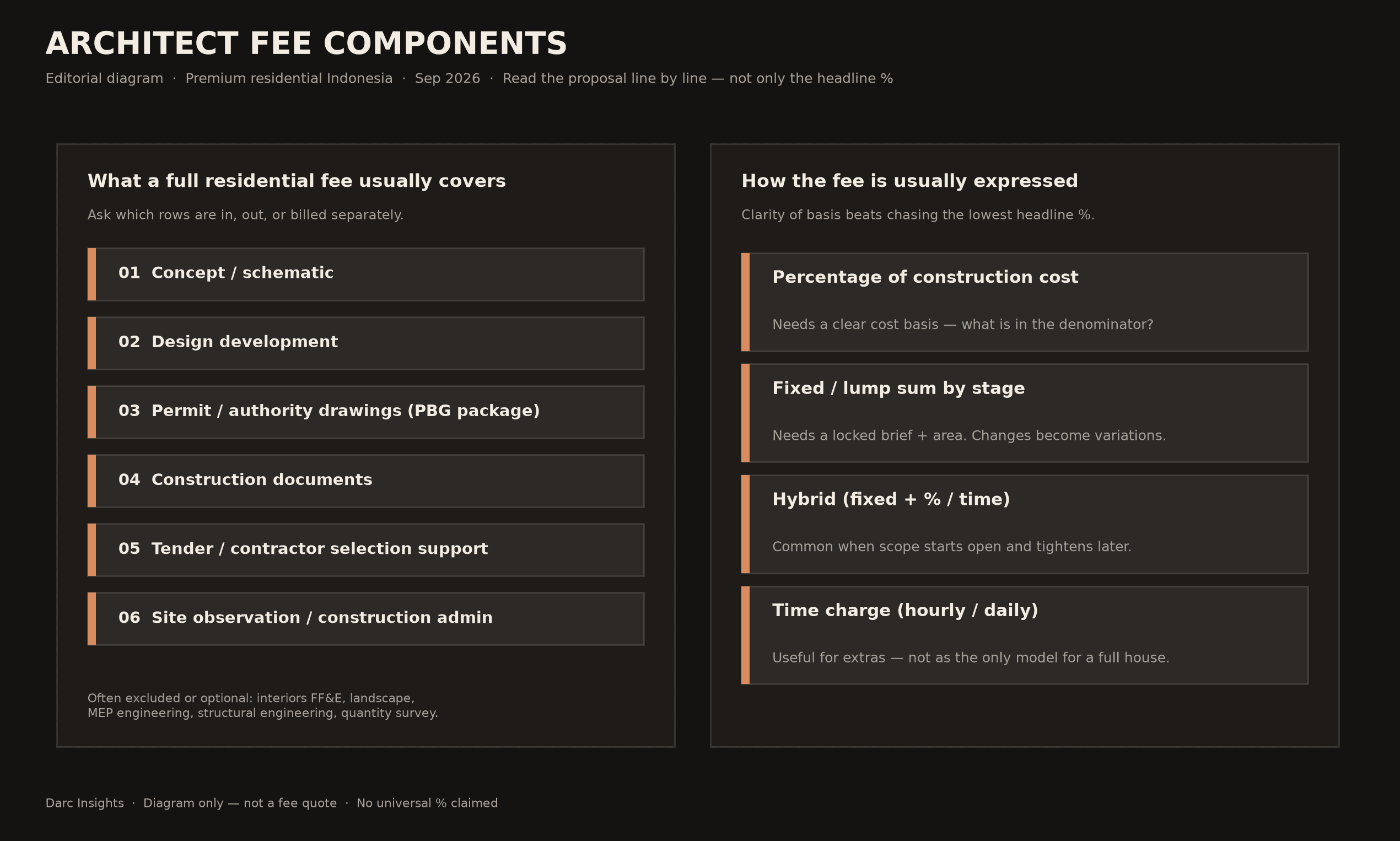
Decide which stages are in the fee, and what document set each stage produces. Typical full-service residential rows (names vary by firm): concept / schematic; design development; permit / authority drawings (PBG package); construction documents; tender / contractor selection support; site observation / construction administration.
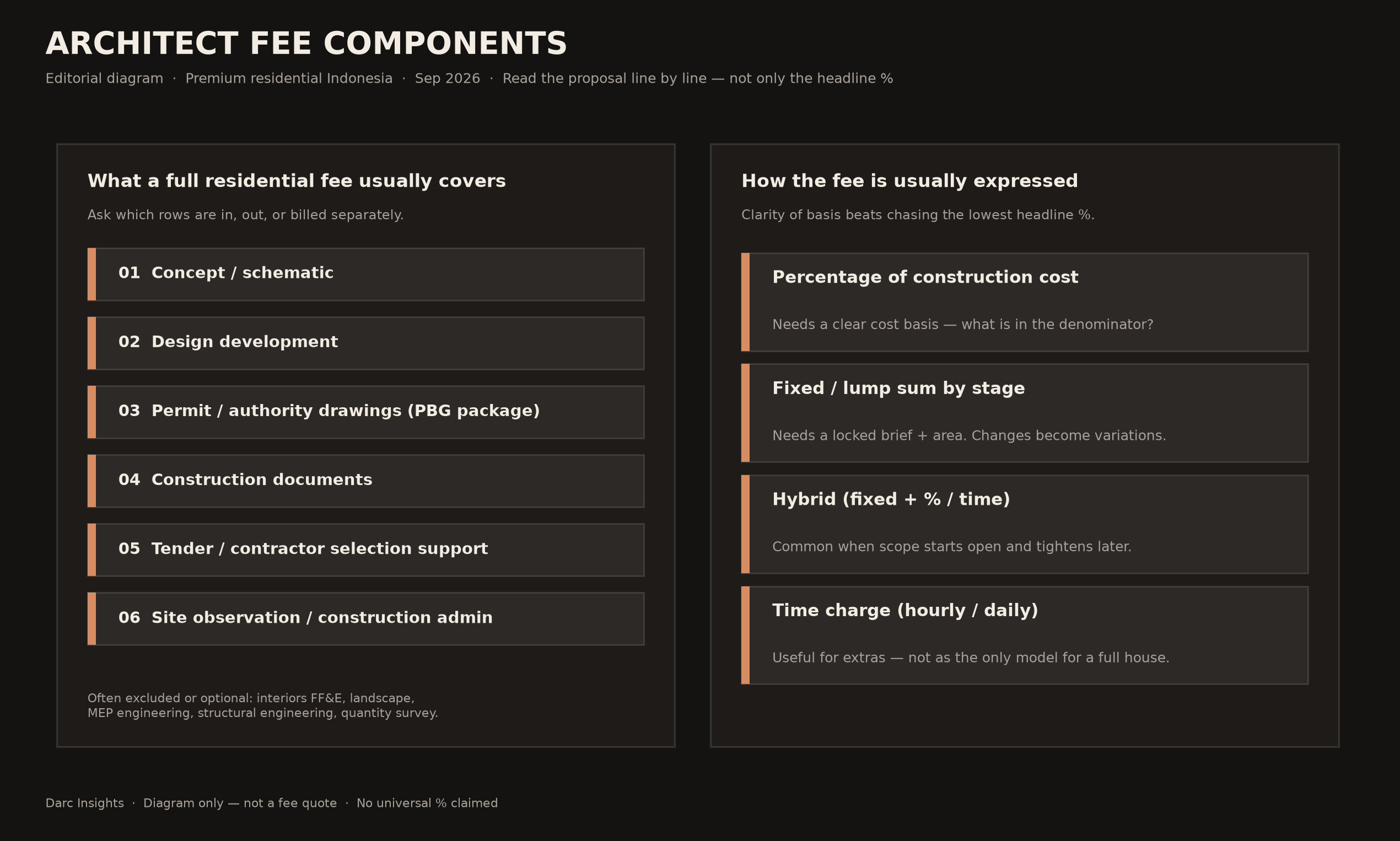
Why it matters: a proposal that only prices schematic looks cheap until you add the rest under pressure. Insist on a stage table with deliverables. If a row is optional, price it as optional — do not bury it.
2. What sits outside the architect fee
Decide which consultants and packages are separate contracts. Often excluded or optional: structural and MEP engineering, quantity survey, interiors FF&E, landscape, specialist lighting or AV, and authority fees themselves (government charges, not the drawing package). Common mistake: assuming “full service” includes engineers and interiors without a line item.
3. How the number is expressed
Decide among percentage of construction cost, fixed/lump sum by stage, hybrid, or time charge for extras. Percentage needs a clear denominator: what construction cost is in or out? Fixed needs a locked brief and area; changes become variations. Hybrid is common when the brief starts open. Time charge suits extras, not as the only model for a whole house. Prefer clarity of basis over chasing the lowest headline %.
4. Revisions, meetings, and site cadence
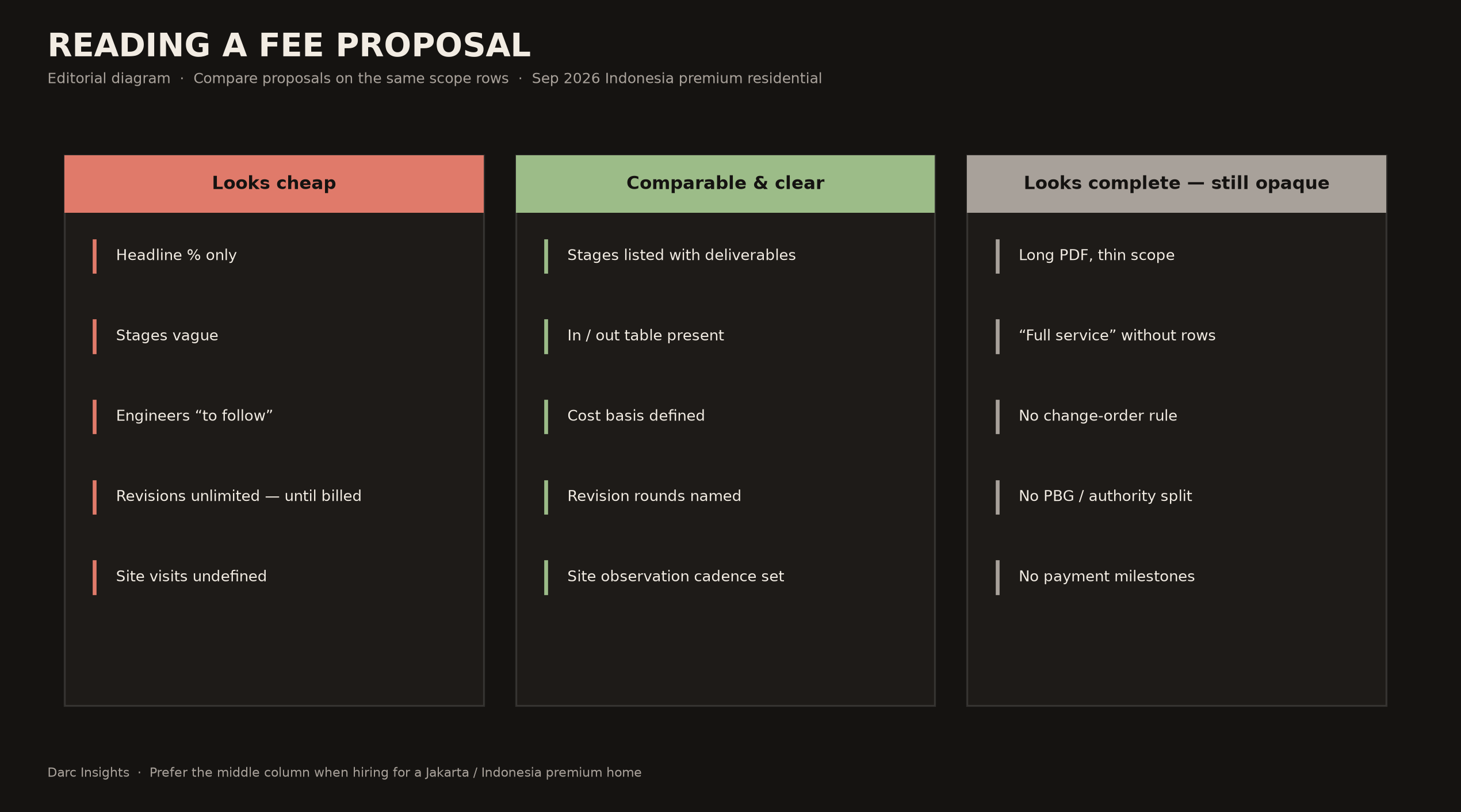
Decide how many design revision rounds are included, how meetings are counted, and how often the architect visits site. Unlimited revisions in marketing copy often become billable change once the schedule slips. Site observation without a visit cadence is a promise without a plan.
From practice
On premium residential work, fee disputes almost never start with the percentage alone. They start when schematic was priced as if it were construction documents, when PBG drawings were assumed included, or when site visits were left undefined while the owner expected weekly presence. Projects such as L House, The Balai, and Cipayung House all required early agreement on which stages, consultants, and observation level matched the build — not a single universal fee formula. We do not invent project measurements here; the lesson is procedural: lock the fee table to the same scope the drawings will carry.
Cost and trade-offs
Assumptions for this section: September 2026, Indonesia, premium residential / villa work, Jakarta as the primary reference market. We do not publish a fake universal architect fee percentage for all luxury homes. Honest drivers of fee level include site and neighbour complexity; depth of documentation for permits and tender; coordination load across engineers and interiors; duration and intensity of construction observation; number of options explored before freeze; and the licensing posture of the practice (STRA / IAI-backed work is not interchangeable with an unlicensed draughting fee).
Ask every shortlisted firm for ranges only with date, city, approximate floor area, stage list, and what is in or out. Treat any single national “standard %” you see online as marketing, not a quote.
Common mistakes
- Comparing headline percentages without matching stage lists.
- Treating PBG / authority drawings as free add-ons.
- Leaving structural and MEP “to follow” with no budget placeholder.
- Accepting unlimited revisions with no change-order rule.
- Hiring on moodboard chemistry before reading exclusions.
- Expecting weekly site presence when the fee only covers monthly observation.
- Using a contractor’s free sketch as a substitute for a licensed architect’s documents on a premium build.
Checklist — before signing a fee proposal
- Stages listed with deliverables (not slogans)
- In / out table for engineers, interiors, landscape, QS
- Cost basis defined if fee is percentage-based
- Revision rounds and meeting cadence named
- Site observation frequency and duration set
- Payment milestones tied to stage completion
- Change-order / variation rule written
- Authority fee vs authority drawing package distinguished
- Author practice licensing stated (STRA / IAI as applicable)
Conclusion
Read an architect fee as a scope contract with a price attached — not as a single glamorous percentage. For a premium Jakarta or Indonesia residence, the winning proposal is the one you can compare row by row, then live with through permits and construction. The limitation: no article replaces a written agreement for your plot and brief.
Related reading
Tropical Modernism Without the Cliché · L House · The Balai · Cipayung House
darcstudio
Darc Studio is a boutique architecture practice focused on tropical modern residences and private villas — Jakarta and tropical sites first.