Boutique Mid-Rise Unit Mix Before You Freeze the Stack
Lock buyer target, core and parking, and tropical elevation strategy before freezing a boutique mid-rise unit mix — short menu, not mass-housing variety. (Sep 2026)

Freeze a boutique mid-rise unit mix only after you lock buyer target, parking and core logic, and which unit types earn the expensive corners. The stack is a commercial and architectural instrument, not a spreadsheet leftover. This guide is for boutique developers and landowner–partners doing small mid-rise — quiet, precise product — not mass housing towers, not “maximize every m²” without a resident story.
Residence and villa owners remain the primary Insights audience; this piece exists because the same studios are often asked to option a small stack before land commitments harden. Hire architectural judgment when the mix must survive tropical comfort, neighbour rules, and sellable plans together. Climate discipline still applies at unit scale: Tropical Modernism Without the Cliché.
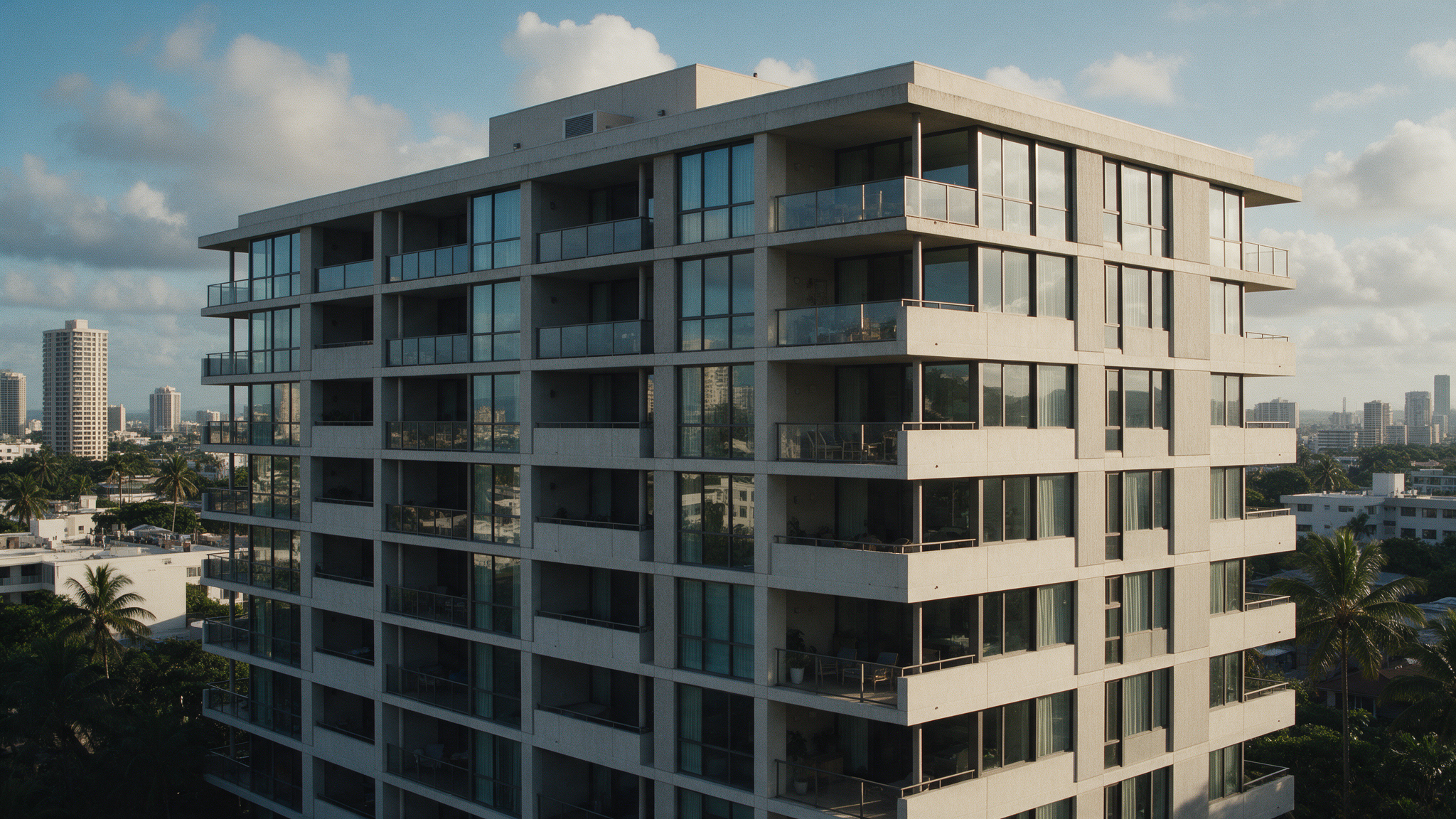
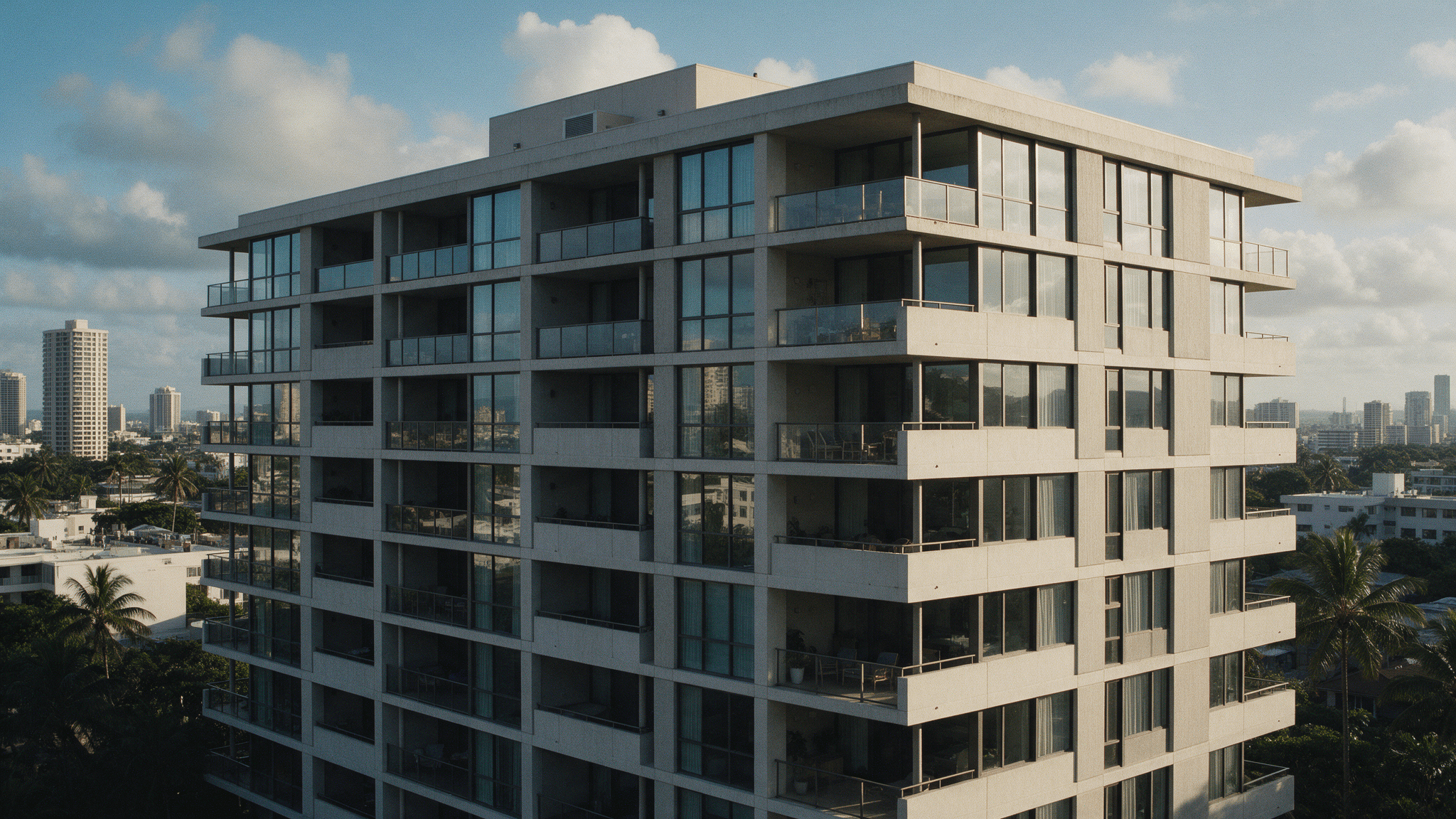
Boutique mid-rise façade
Name the resident before the ticket price
Write one paragraph: who stays nightly, what privacy they buy, how many bedrooms they need, and what they refuse — corridor noise, west glare, no service access. Boutique product dies when every unit is a slightly different compromise of the same bad typical floor.
Site envelope still bounds the fantasy: height, setbacks, local floor-area controls, access width. If you freeze typical-floor CAD before naming who lives there and how the core works, you redraw after marketing starts.
Core and parking delete more options than moodboards admit
Stair and lift core, escape, and parking geometry remove more GFA options than renders show. Place the core where it serves the best unit fronts, not where it leftover-spaces the plan. If parking forces a deep podium, say how upper units recover light and air.
Ground lobby, service, waste, and any amenity must be sized so they do not steal the only good dual-aspect units. Roof decks and mechanical zones need early area claims or they crash into the penthouse story later.
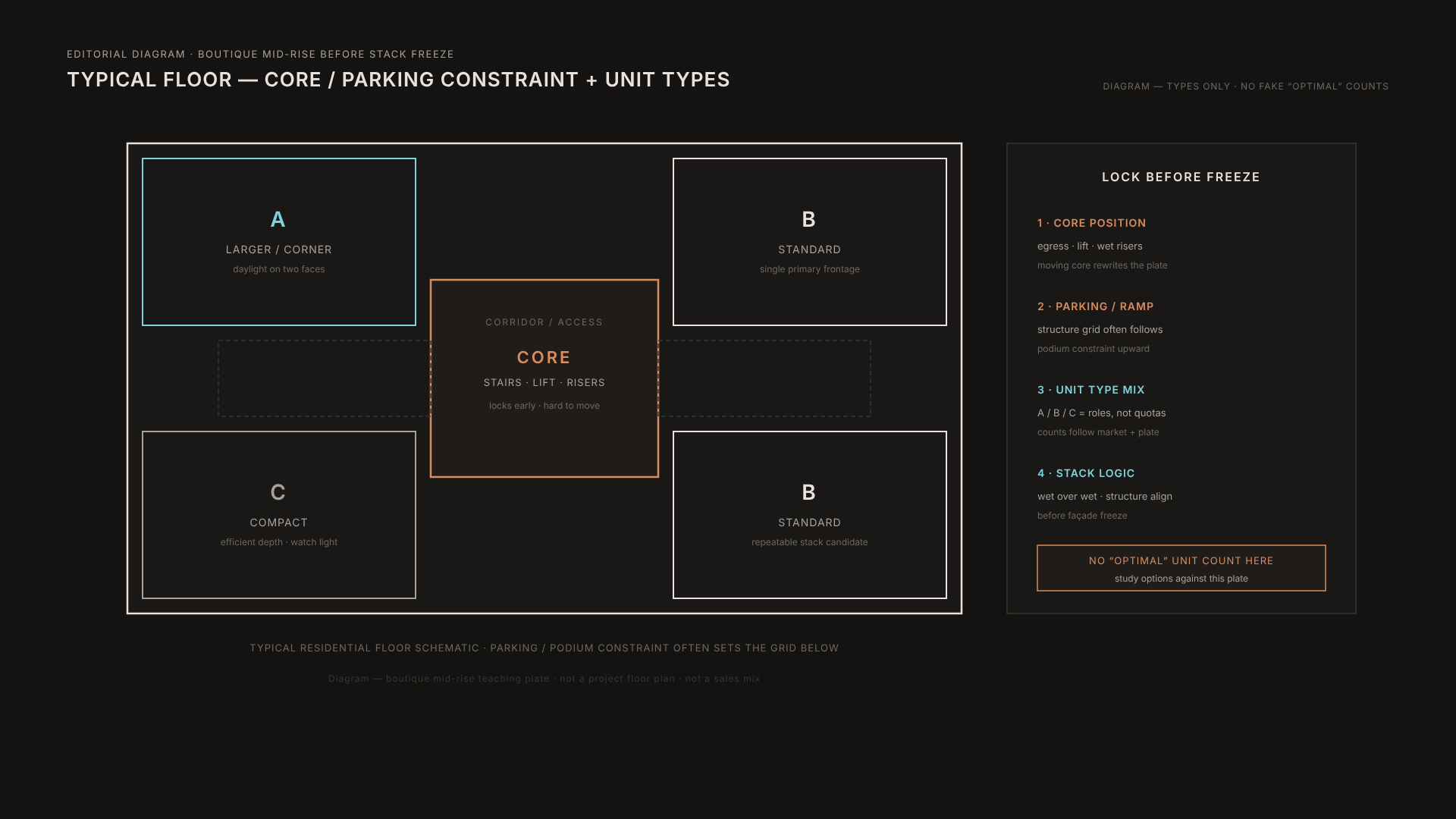
Typical floor with core and unit types A/B/C
A short menu beats fake variety
Boutique stacks usually need a short menu: for example an efficient 1–2 bed, a primary 2–3 bed, and a scarce corner or penthouse type — adjusted to *your* market study, not copied from a tower playbook. Each type should have a reason (price band, family, dual-key only if operations are real). Avoid twelve near-duplicates that share the same dark kitchen and the same west glass.
Unit mix includes which rooms hit harsh elevations. Repeating unprotected west living across every stack level is a comfort and energy liability sold as “view.” Screens, deep loggias, and dual-aspect where the envelope allows are part of mix quality. House-scale orientation still teaches: Tropical House Orientation.
When to hire design authority, not only a unit draughtsman
Hire design authority when envelope options, core placement, and tropical façade strategy must be optioned against yield — not when you only need someone to outline rooms inside a frozen massing. Residential appointment criteria still apply: When a Premium Residence Needs an Architect.
What to freeze early — and the cost of delay:
- Buyer / privacy brief — freeze early; if delayed, marketing redraws plans.
- Core + escape + parking — freeze early; if delayed, the typical floor collapses.
- Unit type count (short menu) — freeze early; delay breeds fake variety and a weak sales story.
- Harsh-elevation strategy — freeze early; delay lets AC and complaints carry the product.
- Amenity / roof claims — freeze early; delay starts a penthouse war with MEP.
- Finish packs — later is OK; do not let finishes invent the mix.
A boutique stack is successful when few unit types are excellent, not when many types are average. Quiet precision beats noisy variety.
What usually fails after a GFA-first freeze
Small mid-rise work that stays coherent options two or three mix scenarios against the same core and parking, then kills the scenarios that only win on paper GFA. The failure pattern is a “luxury” typical floor with deep dark rooms and identical west glass on every level. Freezing from a GFA target without a resident paragraph, placing the core to save corridor while killing the best corners, inventing parking and waste after marketing boards, and claiming amenity in brochures without reserved floor area are the usual redraws.
Private residential projects such as L House, The Balai, and Cipayung House are not mid-rise case studies; they remain useful typology evidence that plan hierarchy and climate response precede finish language. Market absorption and local planning rules are site- and city-specific; this article does not claim a universal mix ratio.
Assumptions: September 2026, boutique mid-rise, Indonesia, hire-intent development. We do not invent sellable price/m², construction Rp/m², or “optimal” mix percentages. More small units can raise count and management load while hurting quiet positioning; larger units can lower count and raise finish expectations; dual-aspect and deep loggias can reduce pure carpet area while improving sellable comfort; cutting façade depth to chase GFA often shifts cost into mechanical systems and slower sales.
Before you freeze the stack: resident or buyer paragraph written; planning envelope and access constraints confirmed; core, escape, and parking option tested; short unit-type menu; harsh-elevation strategy per type; dual-aspect, loggia, or screen where the product promise needs them; ground service and roof MEP area claimed; mix scenarios compared on comfort and operations, not only GFA; appointment scope stated as options study versus documentation-only.
Freeze boutique mid-rise unit mix only after buyer intent, core and parking, and tropical elevation strategy are decided — then keep a short menu of excellent types. Quiet precision over count theatre. This is a decision guide for hire-intent boutique stacks, not a market study and not mass-housing advice.