Water before the pool: five questions for a Bali villa brief
Five water questions to lock with your architect before schematic on a Bali villa: source, catchment, greywater, runoff risk, and pool demand.

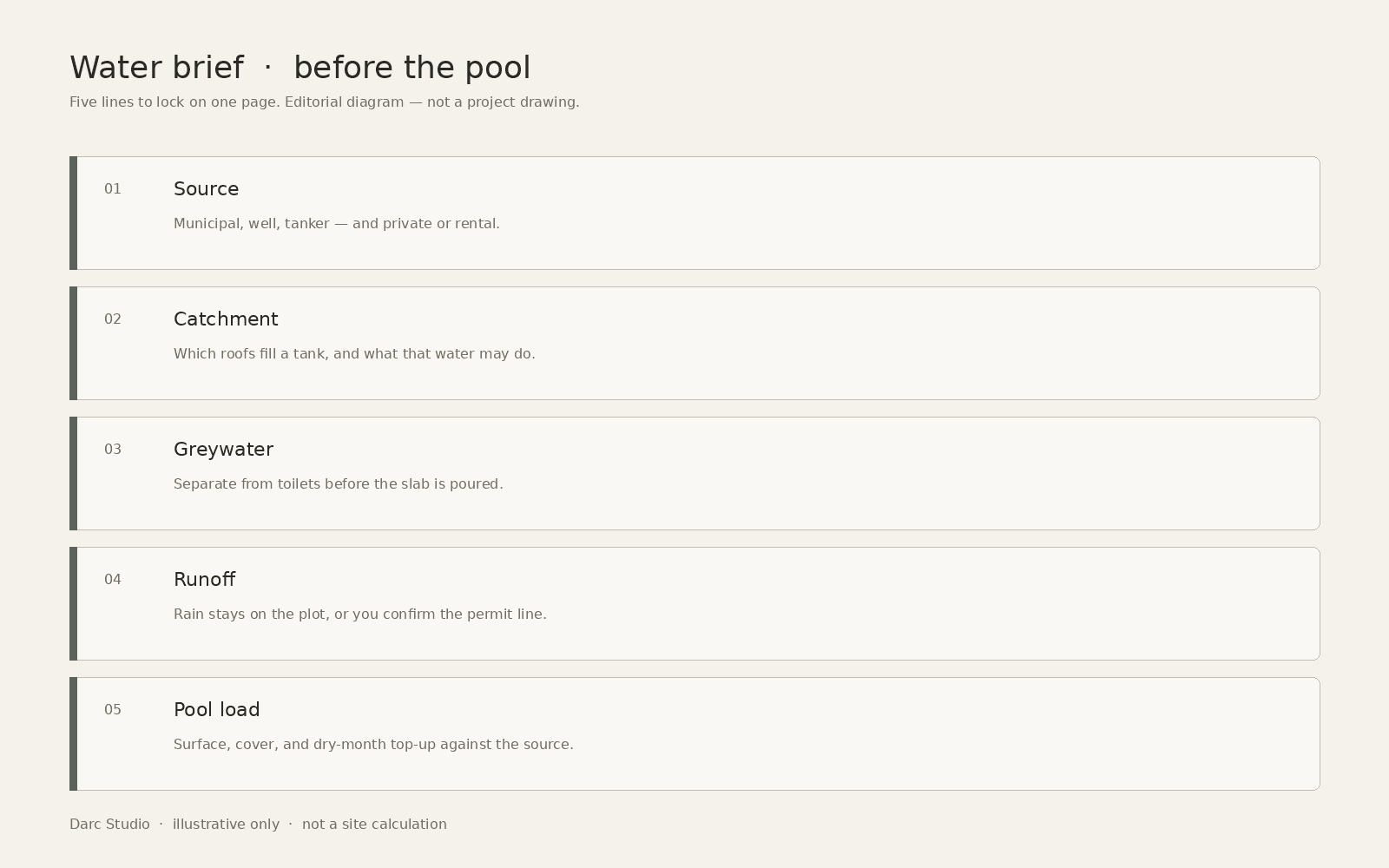
Before schematic, lock five water lines in the villa brief: where water comes from, what the roof can store, whether greywater is piped separately, how rain leaves the plot, and how much the pool will actually drink. On a Canggu–south Bali private villa those decisions set comfort and running cost. A pool drawn as a finish, then fed by a well nobody permitted, is a retrofit. Envelope and shade belong in a different brief: Beyond the Glass Box.
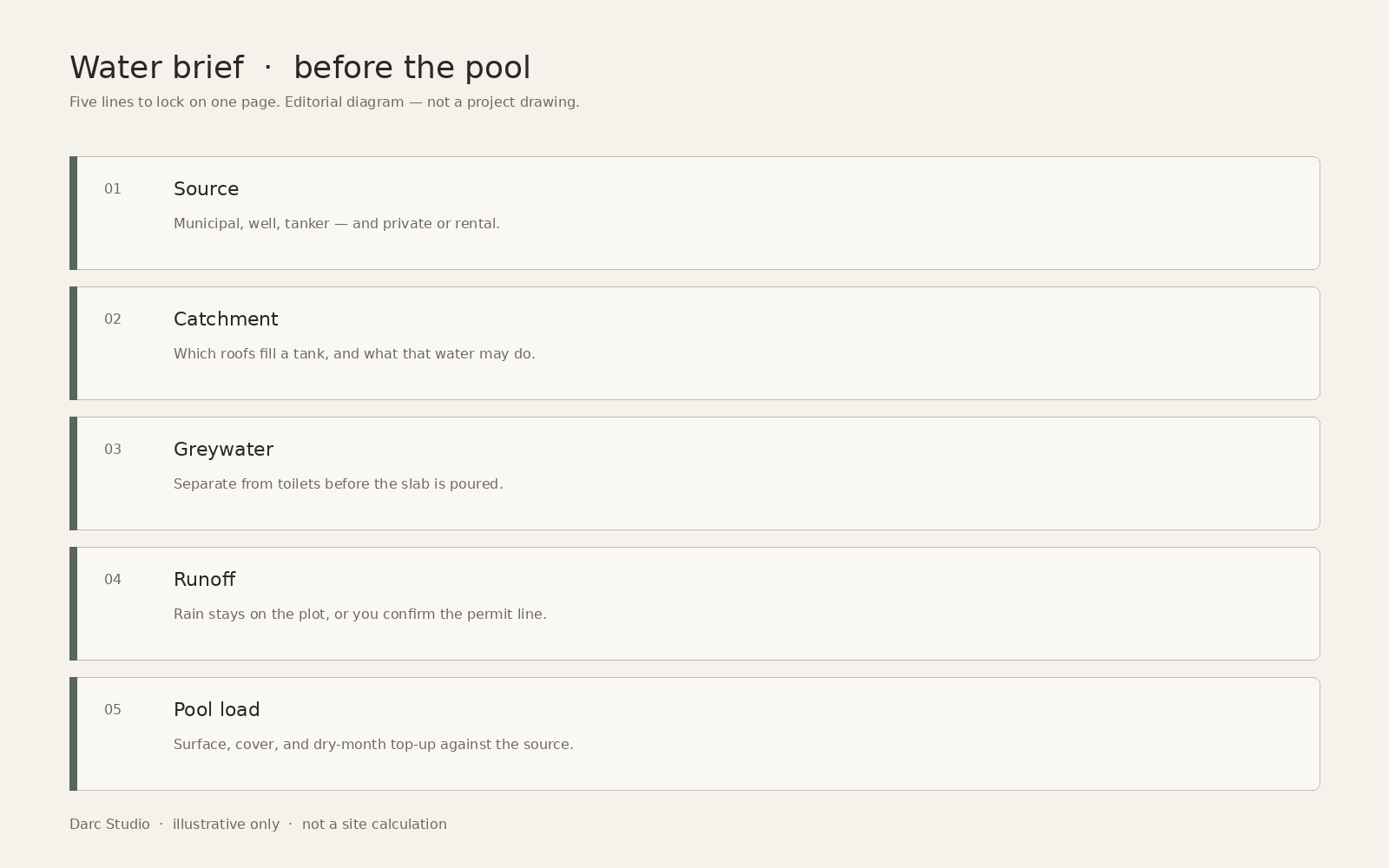
Editorial diagram — five water lines before the pool; not a project drawing and not a site calculation.
Decision context
This is for principals commissioning a private villa on a tropical Bali site, especially Canggu and the south-coast belt, whether the house stays in the family or may later take guests. Hire-intent. Quiet luxury here means water that still works in a dry month, not a rain-chain on a moodboard.
The answer shifts with:
- Household-only use versus a villa that will be rented or staffed like a small operation
- PDAM (municipal) availability versus a well, tanker top-up, or a mix
- Roof area you can honestly catch, and garden or pool area that drinks it
- Plot drainage, neighbour discharge, and whether the street already floods
- How large a pool you refuse to shrink
- Whether you will fund tanks, treatment, and maintenance after handover
If you want a pool photograph and will solve water later, say that in writing. Do not ask the studio to imply the site can carry it.
This is not a permit manual. Sequencing for land, PBG, and SLF sits in Bali villa site, PBG, and SLF. Use that note for process. Use this one for the water questions the architect needs before drawings freeze.
The five questions
Put each answer on one page the household can sign. The studio tests them against the survey. You are locking priorities, not tank sizes.
1. Source — what actually feeds the house
Decide: municipal supply, groundwater, delivered water, or a named mix — and which uses may depend on each.
Why: A south-Bali villa can look settled and still run on a well whose yield, salinity, and legal status were never written down. Guest rooms, a pool, laundry, a kitchen, and irrigation are not the same demand as a small household tap. Advisors treat commercial or high-volume groundwater differently from domestic use. The instrument (often discussed as SIPA, an izin pengusahaan air tanah, or a persetujuan penggunaan air tanah) depends on who has authority for that groundwater basin and on whether the use is usaha. National rules in this area include Permen ESDM No. 14 of 2024 and later ESDM guidance on groundwater permits and approvals; applications for a SIPA are commonly filed through OSS. That is a map of the conversation, not a determination for your parcel.
Write into the brief:
- Intended use: private household, or a villa that may be rented
- Known sources on or near the plot, and what is only hoped for
- Whether a well already exists, and who will obtain current local advice before drilling
- Which rooms and the pool may rely on which source if one fails
Common failure: Calling the project “private” while the brief already assumes paying guests, then discovering the well path is a business permit.
2. Catchment — what the roof can store, and for what
Decide: which roofs drain to a tank, what that water is allowed to do, and what it must not pretend to be.
Why: Rain in south Bali is seasonal. A tank sized to a render, not to roof area and dry-month demand, empties in the weeks you needed it. Stored rainwater is not drinking water unless you specify treatment and testing. It is often honest for irrigation, toilet flush, or controlled pool top-up.
Write into the brief:
- Roofs that may be caught, and roofs you refuse (hot equipment, birded canopies, or chemically treated surfaces)
- Priority uses for stored rain, in order
- Where tanks may sit without stealing the court or the parking you already need
- Who cleans gutters and first-flush in the wet season
3. Greywater — separate it before the slab
Decide: whether showers, basins, and laundry are piped apart from toilets, and what treated greywater may water.
Why: Greywater can reduce irrigation demand after filtration and disinfection. Blackwater cannot share that pipe. The expensive moment is after the floor is poured: a second drain network is a demolition, not a fitting. Treatment, storage, overflow back to the sewer or septic path, and a maintenance owner all belong in schematic, or you should state that reuse is out.
Write into the brief:
- Greywater: in, or explicitly out
- Allowed reuse (irrigation only, or also toilet flush) and what stays forbidden
- Setbacks and odour limits the household will not accept near bedrooms
4. Runoff and permit risk — rain that stays on the plot
Decide: how stormwater leaves the site, and which retention idea you will fund before PBG drawings.
Why: Pushing roof and paving water into the street is how a dry-season villa becomes a neighbour’s flood in a cloudburst. Public reporting after the September 2025 floods described Bali’s public works office pointing villas and hotels back to an on-site, “zero run-off” expectation tied to older provincial water-body protection rules (often cited as Pergub Bali No. 24 of 2020). We do not publish a retention volume, a fee, or a claim that every kabupaten enforces that line the same way. Enforcement is uneven. Your architect and the local process office have to say what your parcel must hold. Do not take a blog’s litre-per-square-metre as your permit condition.
Write into the brief:
- Known flood or backflow on the street or the tukad
- Hardscape you insist on, and where water from that hardscape may pond
- Whether on-site retention is a real landscape room or a pipe you hope to hide
- A line that says: confirm current PBG water and drainage conditions locally before freeze
Permit choreography stays in the PBG and SLF note. Do not let this article become that article.
5. Pool water intensity — the pool is a daily load
Decide: pool area, cover, backwash, and top-up against the source you named in question 1 — before the pool is a shape on the plan.
Why: Evaporation, splash, and filter backwash continue after the party photos. A large uncovered pool on a weak well is a water strategy, not a lifestyle extra. Covers, shade on the water, and a smaller surface cut demand more honestly than a greywater slogan added late. If stored rainwater may top up the pool, say so, and say what happens in a dry month when the tank is empty.
Write into the brief:
- Maximum water surface you will accept
- Cover and shade: required, preferred, or refused
- Top-up source, in order, and the month you will not fill from a tanker
- Whether the pool can shrink if the well or permit advice is poor
Darc take: Lock source, catchment, greywater separation, runoff, and pool demand before schematic freezes the pool and the pavements. Finishes do not create water.
From practice
We do not publish a Bali villa as a post-occupancy water case. There is no studio claim here of a measured well yield, a permitted SIPA, or a tank that carried a dry season. The briefing lesson is organisational: water is a plan decision, the way shade is.
Published work we will not stretch:
- L House is a Design Proposal (Pre-Concept), 2024, on a west-facing lot in Depok, not a Bali hydrology study. The published program includes a rear pool and lounge deck beside parking and service on grade. Useful only as a reminder that a pool arrives with other ground-floor claims. It is not evidence of south-Bali groundwater, salinity, or permits. Studio note: Why L House Was Organised Around This Void.
- Cipayung House and The Balai are not water-security case studies. Do not read their pools, gardens, or screens as a Bali catchment detail.
Limitation: Every banjar, groundwater basin, and flood path differs. A Canggu well reading must not be pasted onto Seminyak or Uluwatu. Ask for advice dated to your parcel.
Cost and trade-offs
Assumptions: October 2026, private villa, south Bali and similar tropical sites. No universal rupiah per square metre, no tank price list, no “zero runoff” construction premium invented here.
What usually moves cost and risk:
- Tanks, treatment, and separate greywater drains drawn in schematic cost structure and maintenance. They are cheaper than opening slabs later.
- An oversized uncovered pool on an uncertain well looks like a single landscape number. It becomes tanker bills, permit exposure, or a pool you cannot fill.
- On-site retention that is actually a planted court spends landscape area. Street discharge spends neighbour goodwill and, where the office enforces it, permit time.
- Skipping local groundwater advice because the villa “feels private” shifts the cost into a stopped pump or a late application.
Ask for dated options against your roof area, pool surface, and the source you really have.
Common mistakes
- Drawing the pool before naming its top-up source and the dry month.
- Treating a household exemption story as permission for a rental villa’s well.
- Quoting another village’s salinity or intrusion study as if it were your plot.
- Combining rainwater and wastewater in one pipe because the section was tight.
- Promising greywater irrigation with no treatment, overflow, or person who services it.
- Sending all paving and roof water to the street, then calling the garden sustainable.
- Letting a rainwater moodboard replace a one-page brief the owner will sign.
Checklist — before schematic freezes the pool
- Use named: private household or possible rental
- Source order written (municipal, well, tanker, rain)
- Local groundwater advice requested before any new drilling
- Roofs that drain to a tank, and banned uses of that water
- Greywater in or out; blackwater never mixed in
- Stormwater: stay on plot or leave — and who confirms the current permit line
- Pool surface cap, cover, and dry-month top-up
- Maintenance owner for gutters, tanks, filters, and treatment
- No reused climate-envelope decisions pretending to be a water strategy
Conclusion
A Bali villa brief that respects water answers five questions before the pool is a shape: source, catchment, greywater, runoff, and pool demand. Priority for the first owner meeting is that one page, checked against the survey, not a larger water feature.
Limitation: This is not legal advice, not a SIPA or PBG filing, and not a retention calculation. Rules and enforcement change by basin and kabupaten. Confirm current conditions with someone who files them.
Related reading
- Bali villa site, PBG, and SLF — permit sequencing, not water design
- Beyond the Glass Box — envelope and shade; do not merge with this brief
- Tropical House Orientation
- Choosing an Architect for a Premium House in Jakarta — brief discipline, different city
“A pool drawn as a finish, then fed by a well nobody permitted, is a retrofit.”